

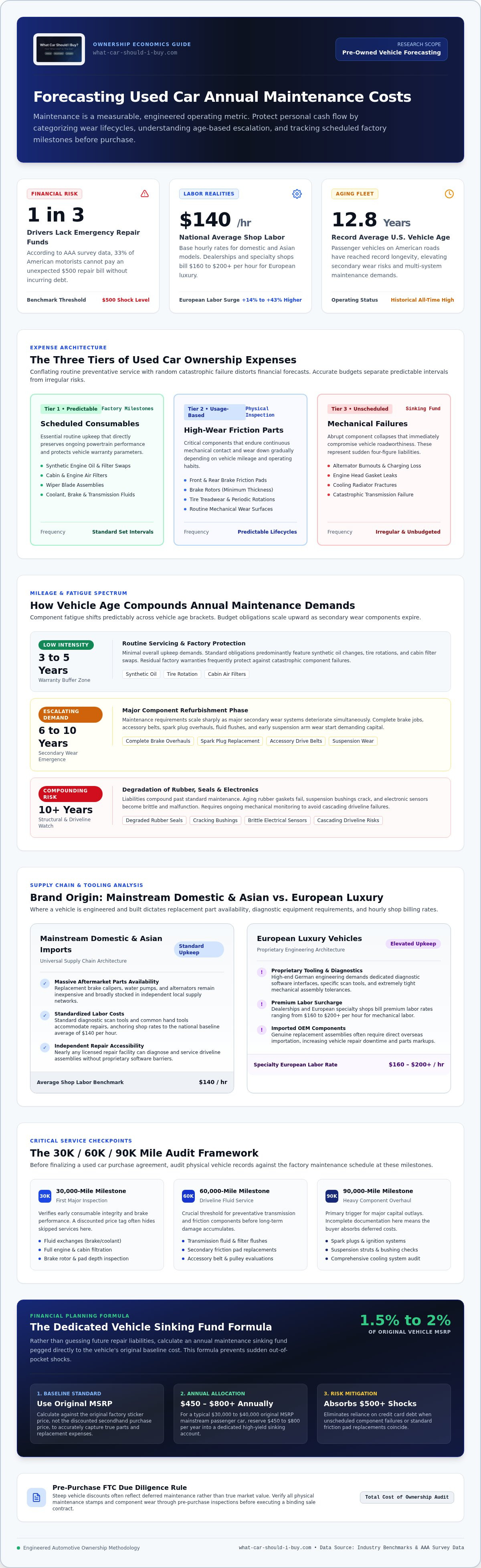
One in three American drivers cannot afford an unexpected $500 repair bill without taking on debt, according to survey data from AAA. If you're evaluating pre-owned vehicles, projecting realistic used car annual maintenance costs before you sign a purchase agreement is the single best way to protect your finances from sudden shocks.
It's completely natural to fear unbudgeted mechanical breakdowns, or to feel confused about where basic scheduled servicing ends and four-figure repair invoices begin. That hesitation is justified when national shop labor averages $140 per hour, parts costs keep climbing, and passenger vehicles on U.S. roads average a record 12.8 years of age.
You don't have to treat ownership expenses like an unpredictable gamble. Maintenance is an engineered, measurable operating metric. This guide delivers an accurate methodology to forecast your yearly expenses, benchmarks across vehicle segments and mileage thresholds, and concrete criteria to eliminate high-maintenance money pits before you buy.
Key Takeaways
- Distinguish routine wear items from sudden mechanical failures to accurately calculate true used car annual maintenance costs.
- Evaluate brand origin and powertrain complexity early, as parts availability drives long-term ownership expenses more than the initial purchase price.
- Track scheduled 30,000, 60,000, and 90,000-mile service milestones to anticipate major component replacements before you finalize a deal.
- Audit historical service records against the factory maintenance schedule to identify neglected repairs and eliminate high-risk models.
- Apply the 1.5% to 2% original MSRP formula to establish a dedicated vehicle sinking fund that prevents unexpected cash outlays.
What Constitutes Used Car Annual Maintenance Costs?
Calculating used car annual maintenance costs requires separating predictable servicing from unexpected mechanical breakdowns. Many buyers treat every dollar spent at an auto shop as generic maintenance. This assumption distorts realistic financial planning. Scheduled preventative upkeep preserves performance, while unplanned failure repairs address broken components that halt operation entirely.
A vehicle's sticker price often reflects deferred maintenance rather than real-world value. A steep discount on a secondhand car frequently conceals skipped transmission flushes, bald tires, or thinning brake rotors. Evaluating these ongoing liabilities forms a critical part of calculating your overall total cost of ownership. Buying a neglected vehicle forces the subsequent owner to pay upfront for the previous owner's deferrals.
Routine Preventative Upkeep vs. Unscheduled Mechanical Repairs
Clear budgeting divides automotive expenses into three distinct categories:
- Scheduled consumables: Engine oil, cabin and engine air filters, wiper blades, and regular fluid exchanges (coolant, brake fluid, and transmission fluid).
- High-wear friction components: Brake pads, brake rotors, and tires. These degrade predictably through daily driving.
- Unscheduled mechanical failures: Alternator burnouts, head gasket leaks, radiator cracks, and complete transmission failures. These are catastrophic repairs rather than standard maintenance.
Preventative upkeep occurs at set mileage intervals dictated by factory engineers. Wear items follow predictable life cycles based on driving habits. Major system failures, conversely, happen irregularly and demand separate emergency cash reserves.
The Baseline Annual Cost Spectrum by Vehicle Age
Age alters component fatigue. As odometers advance, your baseline used car annual maintenance costs shift along a measurable timeline:
- Vehicles aged 3 to 5 years: Expect minimal upkeep. Standard obligations usually involve regular synthetic oil changes, tire rotations, and cabin filter swaps. Factory warranties often buffer unexpected failure liabilities.
- Vehicles aged 6 to 10 years: Upkeep demands escalate. Major secondary wear items emerge, including full brake jobs, spark plug replacements, accessory belts, and multiple fluid flushes. Suspension components begin showing physical wear.
- Vehicles aged 10+ years: Maintenance liabilities compound. Beyond standard fluid and tire rotations, aging rubber seals degrade, suspension bushings crack, and electronic sensors become brittle. Maintenance here requires steady, ongoing mechanical monitoring to prevent cascading driveline failures.
Primary Variables That Dictate Used Car Maintenance Expenses
Two identical vehicles with matching mileage can generate radically different repair bills. Wear cycles do not happen in isolation. Brand supply chains, technician specialization, and powertrain architecture dictate how fast expenses accumulate. Understanding these operational drivers allows you to project used car annual maintenance costs with precision rather than guesswork.
Before purchasing, smart buyers review physical vehicle records and verify component wear. Aligning your pre-purchase research with the FTC's guidance on used car pre-purchase inspections helps you identify deferred mechanical needs before contracts are signed. If you are weighing multiple prospective models, generating an objective Head-to-Head Car Comparison provides clear visibility into long-term mechanical risks.
Brand Origin: Mainstream Domestic, Asian Imports, and European Luxury
Where an automaker designs and builds a vehicle directly shapes replacement part supply chains. Mainstream domestic and Asian vehicles benefit from massive aftermarket manufacturing. Replacement brake calipers, water pumps, and alternators remain inexpensive and widely stocked at independent auto shops. Standard repair jobs require universal diagnostic gear and common hand tools.
European luxury vehicles operate under a completely different cost framework. High-end German engineering demands specialized diagnostic scan tools, proprietary software interfaces, and tight mechanical tolerances. Dealerships and specialty European shops frequently bill $160 to $200 or more per labor hour. Genuine OEM components must often be imported, increasing repair downtime and parts markup.
Powertrain Complexity: Naturally Aspirated, Turbocharged, and Hybrid Systems
Mechanical complexity directly influences lifetime upkeep schedules. Simpler engine configurations generally deliver lower long-term service exposure:
- Naturally aspirated engines: Operate at lower internal temperatures and pressures. They require standard oil change frequencies and straightforward valve-cover or accessory gasket replacements.
- Turbocharged engines: Subject motor oil to extreme thermal stress. High-pressure direct-injection systems, intercoolers, and wastegate actuators introduce additional service points that elevate used car annual maintenance costs as mileage climbs.
- Hybrid powertrains: Reduce overall mechanical friction. Regenerative braking extends brake pad life significantly, often past 80,000 miles. However, hybrids require dedicated inverter cooling system maintenance, high-voltage battery filter cleanings, and specialized technician diagnostics.
- AWD and 4WD drivelines: Introduce additional fluids and wear points. Center transfer cases, front differentials, and rear differentials all require fluid flushes every 30,000 to 60,000 miles, adding recurring costs absent in front-wheel-drive configurations.
Predictable Upkeep Milestones vs. Expensive Wear Components
Automotive maintenance follows a structured clock governed by distance and mechanical fatigue. Federal benchmarks, including Bureau of Transportation Statistics data on vehicle operating costs, demonstrate that per-mile driving expenses rise steadily as components complete their engineered design lifecycles. Budgeting accurately requires knowing exactly when routine service stops being a simple oil change and turns into major component renewal.
Ignoring these cycles leads to compounded liabilities. A used vehicle acquired right before a major service boundary often forces you to fund overdue maintenance within weeks of taking delivery. Factoring upcoming mileage thresholds directly into your used car annual maintenance costs prevents these sudden outlays from catching you off guard.
Major Service Interval Milestones (30k, 60k, 90k, and 100k Miles)
Factory maintenance schedules group critical procedures into predictable odometer thresholds:
- 30,000-Mile Interval: Light preventative servicing. Tasks include fresh engine and cabin air filters, thorough brake fluid exchanges to remove moisture, and tire rotations.
- 60,000-Mile Interval: Moderate mechanical renewal. Requires transmission fluid exchanges, engine coolant flushes, differential fluid replacements, and standard spark plug intervals on non-iridium systems.
- 90,000 to 100,000-Mile Interval: Heavy mechanical servicing. This benchmark requires platinum or iridium spark plug renewal, drive belt tensioner replacement, and PCV valve service.
The 90,000-mile mark demands special attention to engine timing architecture. Timing belts must be replaced along with the water pump and front tensioners every 60,000 to 100,000 miles, generally running $900 to $1,800. If a rubber belt breaks on an interference engine, the pistons strike open valves, turning routine servicing into an engine replacement costing upwards of $3,000. Timing chains, by contrast, use metal links lubricated by engine oil and normally last the operational life of the vehicle if oil changes occur on schedule.
Secondary Chassis and Suspension Wear Items
Rubber and hydraulic chassis parts degrade quietly from road vibration and atmospheric oxidation. By 80,000 to 120,000 miles, front lower control arm bushings dry-rot, causing steering vagueness and accelerated tire wear. Replacing front suspension control arms, ball joints, and outer tie rods typically requires $500 to $1,200 per axle, including alignment.
Struts and shock absorbers steadily lose damping efficiency over 75,000 miles. Blown hydraulic seals create excessive vehicle bounce and irregular tire cupping. Brake caliper slider pins also seize over time, especially in environments exposed to moisture or road de-icers, causing premature pad wear and warped rotors that elevate your ongoing used car annual maintenance costs.
How to Forecast Annual Maintenance Costs Before Buying
Accurate forecasting requires an empirical audit rather than casual visual inspection. Dealership sales hype often masks deferred mechanical liabilities behind clean floor mats and freshly polished paint. You must quantify upcoming upkeep obligations before negotiating a purchase price. Bringing a structured Used Car Buying Checklist to the vehicle walkaround ensures you systematically catch wear indicators before signing paperwork.
Every pre-owned vehicle carries an invisible balance sheet of upcoming expenses. Calculating this ledger requires cross-referencing documented mechanical history directly against the vehicle's current odometer reading. When you synthesize real operating records with known component failure rates, you establish a baseline projection for your true used car annual maintenance costs.
Step-by-Step Maintenance Record and History Verification
Verify maintenance documentation using a three-phase review protocol:
- Audit oil change intervals: Confirm services match severe-duty schedules (typically every 5,000 miles for conventional or 7,500 miles for full synthetic). Large gaps in service history indicate extended periods of lubrication breakdown.
- Map upcoming factory milestones: Match the current odometer against the owner's manual. A vehicle sold at 58,000 miles likely has an expensive 60,000-mile service immediately due, transferring that financial liability directly onto you.
- Inspect consumable lifespans: Check tire manufacturing date codes and remaining tread depth. If tires are over six years old or measure below 4/32-inch, calculate an immediate replacement cost of $600 to $1,200.
- Cross-reference open TSBs: Check official safety databases for technical service bulletins and unresolved factory recalls on critical systems like power steering, fuel delivery, or electrical modules.
Evaluating Parts Availability and Independent Labor Networks
A vehicle's purchase market determines its servicing friction. Before committing to an unfamiliar model, verify that independent mechanics in your area possess the diagnostic capabilities to service that specific nameplate. Mass-market domestic and Japanese brands enjoy broad support, allowing you to bypass dealership labor premiums entirely.
Check common replacement parts pricing on national auto parts retail platforms. Basic items like alternators, starters, and brake master cylinders should be inexpensive and stocked locally. Low-volume orphan brands or niche European imports often face multi-week supply backorders from overseas warehouses, multiplying your downtime and inflating ongoing used car annual maintenance costs.
Data-Driven Ownership: Structuring Your Annual Maintenance Budget
Many dealership finance offices push expensive aftermarket vehicle service contracts. These third-party warranties often carry restrictive coverage exclusions, deductibles, and claim denial clauses. Self-funding your upkeep through an analytical sinking fund gives you complete control over your capital while eliminating interest charges and administrative disputes.
A dependable budgeting benchmark is the 1.5% to 2% rule. Calculate 1.5% to 2% of the vehicle's original manufacturer suggested retail price (MSRP), not its discounted secondhand purchase price. A crossover that originally stickered at $32,000 requires roughly $480 to $640 annually for basic preventative upkeep. For older vehicles operating past 100,000 miles, adjust this metric upward toward 3% to 4% to absorb aging chassis, ignition, and cooling components.
Calculating an Objective Sinking Fund for Upkeep
Structure a dedicated high-yield savings account strictly for automotive operating expenses. Automate a monthly transfer of $75 to $150 based on your vehicle's age, odometer reading, and mechanical complexity. This disciplined allocation protects your primary checking account from sudden garage invoices.
Liquid reserves buffer you against multi-year wear cycles. A fresh set of tires and complete front and rear brake replacements can easily total $1,500 combined. Amortizing these predictable wear expenditures across a rolling 36-month timeline prevents regular component fatigue from disrupting your broader household finances.
Comparing Rival Used Cars on Long-Term Running Metrics
Identical price tags between two secondhand models often disguise radically different operating expenses. A ten-year-old luxury sedan and a five-year-old mainstream compact might sell for the exact same transaction price today, yet their ongoing parts availability and shop labor requirements diverge immediately. Evaluating running cost metrics before purchase eliminates costly post-sale surprises.
Synthesizing verified vehicle data through What Car Should I Buy? allows you to benchmark realistic used car annual maintenance costs across competing options using unbiased research models. Knowing your exit threshold is equally vital. When documented maintenance and mechanical repairs eclipse 50% of a vehicle's clean private-party valuation within a single calendar year, the asset has hit economic obsolescence and demands replacement.
Take Control of Your Pre-Owned Operating Expenses
Anticipating used car annual maintenance costs transforms pre-owned vehicle shopping from a stressful gamble into a manageable evaluation problem. By separating routine consumable wear from catastrophic component failures, auditing service logs against factory schedules, and establishing a dedicated sinking fund based on original MSRP, you protect your household finances from post-purchase shocks.
Disciplined data analysis beats dealership sales pressure every single time. Before committing your hard-earned capital, run a multi-source vehicle analysis on What Car Should I Buy? to access objective reliability scoring, detailed running cost forecasting, and structured side-by-side model comparisons.
Arming yourself with verified operating metrics eliminates the guesswork from car shopping. You can navigate the pre-owned market with complete confidence, knowing your chosen vehicle will remain affordable and dependable for every mile ahead.
Frequently Asked Questions
How much should I budget annually for used car maintenance?
Budget between $900 and $1,200 per year for a standard pre-owned vehicle in sound operational condition. This baseline allocation handles regular oil changes, filter renewals, tire rotations, and scheduled fluid flushes. For vehicles past ten years of age or 100,000 miles, increase your annual budget reserve to roughly 3% to 4% of the car's original MSRP to absorb secondary chassis and cooling system wear.
What is the difference between car maintenance and car repair?
Maintenance consists of scheduled, preventative servicing designed to preserve component lifespans, while repairs fix unanticipated mechanical breakdowns. Routine maintenance covers predictable wear consumables such as fluids, filters, brake pads, and timing belts. Mechanical repairs address sudden part failures like blown alternators, fractured radiators, or broken transmissions. Confusing these two distinct categories distorts your true used car annual maintenance costs.
Do older used cars always cost more to maintain each year?
Yes, older vehicles almost always cost more to maintain because multiple mechanical assemblies reach the end of their engineered lifespans simultaneously. While depreciation flattens after five years, physical component fatigue accelerates. Rubber suspension bushings, coolant hoses, vacuum lines, and drive seals dry out and crack with age. Even vehicles with immaculate oil service logs face mounting upkeep liabilities once odometers cross six figures.
Can regular maintenance prevent catastrophic engine and transmission failure?
Consistent preventative maintenance prevents the vast majority of catastrophic driveline failures. Engines and transmissions fail prematurely primarily due to fluid breakdown, thermal breakdown, or ignored wear items. Neglected oil changes cause variable valve timing mechanisms to clog, while old transmission fluid allows internal friction plates to overheat. Replacing a timing belt on schedule stops pistons from striking open valves, avoiding multi-thousand-dollar rebuild bills.
How can I find out the exact maintenance schedule for a used car?
Check the manufacturer factory service manual or scheduled upkeep booklet published specifically for your vehicle's model year. Automakers make digital PDF editions available through their customer web portals at no cost. These manuals outline maintenance intervals divided into normal and severe-duty schedules. If your driving includes stop-and-go city traffic, heavy winter temperatures, or regular towing, follow the severe-duty timetable.
Is it cheaper to maintain an Asian import, domestic, or European luxury used car?
Mainstream Asian and domestic nameplates are significantly cheaper to keep on the road than European luxury vehicles. Brands like Toyota, Honda, Ford, and Chevrolet rely on vast aftermarket supply chains, making replacement parts cheap and accessible for independent mechanics. European luxury models require specialized diagnostic scan tools, higher shop labor door rates, and expensive imported components, substantially elevating your used car annual maintenance costs.
What happens if a previous owner skipped major scheduled maintenance intervals?
Skipping scheduled service intervals transfers expensive deferred maintenance liabilities and hidden structural wear directly to the subsequent owner. Degraded engine oil accelerates camshaft wear, while aged coolant turns acidic and corrodes water pump impellers from within. When a previous owner neglects 60,000 or 90,000-mile milestones, you inherit those compounded mechanical obligations, forcing immediate out-of-pocket expenses right after purchase.

