

A bargain sticker price often masks the most expensive car on the lot. True ownership economy stems from mechanical simplicity and widespread parts availability, not aggressive dealer discounts. If your goal is finding reliable used cars with low repair costs, you must look beyond generic review scores and evaluate long-term component durability.
Dealership labor rates now run between $150 and $250 per hour, turning minor garage visits into major financial setbacks. Between the fear of concealed transmission defects and contradictory forum advice, shopping the secondary market can feel like a stressful gamble. It's frustrating when true ownership expenses remain hidden until the first breakdown.
You don't have to guess. This guide identifies durable pre-owned models engineered with resilient, accessible components that keep annual shop bills to a minimum. Below, we analyze repair profiles across compacts, midsize sedans, and crossovers, pairing each segment with a systematic inspection protocol to protect your investment before you buy.
Key Takeaways
- Separate routine fluid changes from catastrophic powertrain risks to calculate true long-term maintenance exposure accurately.
- Discover proven compacts, midsize sedans, and crossovers that deliver reliable used cars with low repair costs across 2014 to 2021 model years.
- Identify why naturally aspirated engines and traditional torque-converter gearboxes systematically minimize unplanned garage expenses.
- Deploy a systematic five-step mechanical inspection protocol to verify component health before negotiating a purchase price.
- Eliminate emotional bias by balancing initial acquisition price against verified component longevity and fuel consumption data.
Evaluating Reliable Used Cars With Low Repair Costs: Key Metrics
Most vehicle rankings lump oil changes together with blown transmissions. That flaw produces misleading scores. Identifying genuine reliable used cars with low repair costs requires measuring two distinct variables: scheduled wear intervals and unscheduled catastrophic failures. Calculating true total cost of ownership demands separating routine servicing from mechanical breakdown risk.
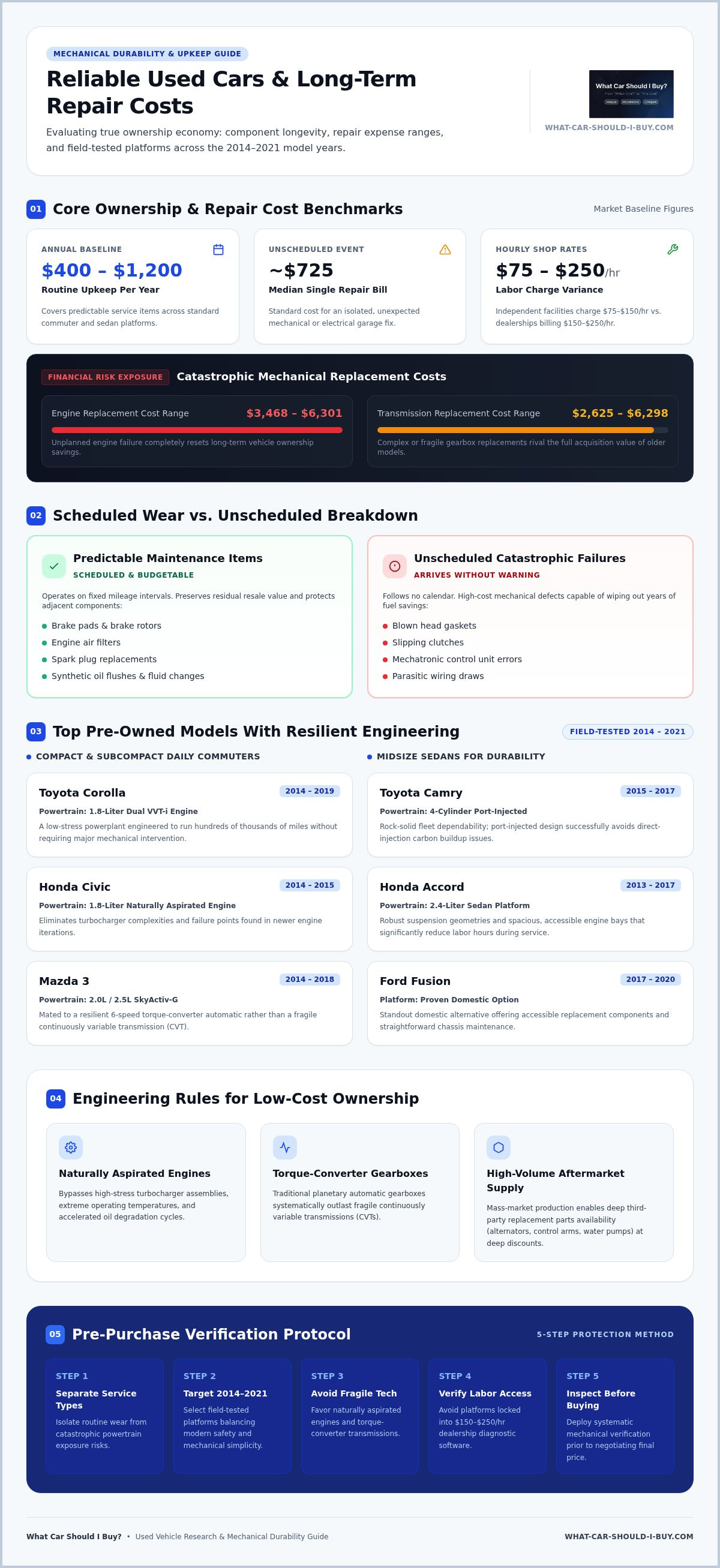
Annual maintenance typically ranges from $400 to $1,200 per year across most platforms. Meanwhile, the median cost for an individual unexpected repair is roughly $725. Factoring in extreme mechanical events changes the financial calculus immediately. Engine replacements average between $3,468 and $6,301, while replacement transmissions demand between $2,625 and $6,298. To protect capital, review empirical failure frequencies using a structured used car reliability report before committing to an unvetted platform.
Unscheduled Repairs vs. Routine Maintenance
Wear items operate on predictable cycles. Brake pads, brake rotors, engine air filters, spark plugs, and synthetic oil flushes occur at set intervals. You can budget for them accurately years ahead of time. These routine service actions preserve residual resale value by preventing accelerated mechanical wear across adjacent assemblies.
Unscheduled failures follow no calendar. Blown head gaskets, slipping clutches, sudden mechatronic control unit errors, and parasitic wiring draws arrive without warning. They leave you stranded. One catastrophic transmission failure can erase five years of fuel savings in an afternoon, destroying personal budgets.
Parts Availability and Independent Labor Rates
Vehicle sales volumes dictate future replacement parts availability. Mass-market commuter sedans produced across hundreds of thousands of units enjoy deep, competitive aftermarket supply chains. You can source alternators, control arms, and water pumps through multiple third-party suppliers at substantial discounts compared to factory components.
Labor charges impact overall repair invoices just as heavily as wholesale components:
- Independent repair facilities: General shops bill between $75 and $150 per hour, readily servicing platforms built with conventional hardware.
- Franchised dealerships: Dealership labor rates range from $150 to $250 per hour, often mandatory for boutique vehicles requiring locked diagnostic tools.
- Diagnostic hurdles: Vehicles requiring proprietary manufacturer software lock buyers into expensive dealership service bays for simple component calibrations.
Prioritizing mechanically straightforward platforms keeps repair invoices low. High production volumes combined with simple access points allow independent mechanics to diagnose, service, and clear repairs quickly without demanding proprietary equipment.
Top Pre-Owned Models Delivering Proven Reliability and Manageable Upkeep
Targeting reliable used cars with low repair costs requires focusing on proven platforms built between 2014 and 2021. These model years represent an ideal balance, combining structural safety with field-tested mechanical engineering. Before committing capital to any vehicle, check our baseline breakdown of used car annual maintenance costs to align expected upkeep with your household budget.
Compact and Subcompact Daily Commuters
The 2014 to 2019 Toyota Corolla relies on a simple 1.8-liter dual VVT-i engine, a low-stress powerplant that runs hundreds of thousands of miles without major intervention. Similarly, the 2014 to 2015 Honda Civic uses a naturally aspirated 1.8-liter unit, bypassing the turbocharger complications found in newer revisions. The 2014 to 2018 Mazda 3 also excels; its 2.0-liter and 2.5-liter SkyActiv-G engines mate to a resilient six-speed torque-converter automatic instead of a fragile continuously variable transmission (CVT).
Midsize Sedans for Long-Distance Durability
Four-cylinder Toyota Camry models from 2015 to 2017 deliver rock-solid fleet dependability, avoiding direct-injection carbon buildup through port-injected engineering. The 2013 to 2017 Honda Accord 2.4-liter sedans provide robust suspension geometries and accessible engine bays that cut labor hours during routine servicing. A standout domestic option is the 2017 to 2020 Ford Fusion equipped with the naturally aspirated 2.5-liter Duratec four-cylinder, which avoids the coolant intrusion flaws that plague smaller EcoBoost engines.
Practical Compact Crossovers and Hatchbacks
The 2015 to 2018 Toyota RAV4 combines an unbothered 2.5-liter engine with a traditional six-speed gearbox, avoiding costly electronic all-wheel-drive failures. For Honda fans, the 2012 to 2014 CR-V uses the durable K24 engine prior to the arrival of direct-injection oil dilution issues. Budget shoppers can target the Pontiac Vibe and Scion xB, both of which hide indestructible Toyota drivetrains beneath utilitarian bodywork. While inspecting drivetrains, cross-referencing official NHTSA 5-Star Safety Ratings verifies crashworthiness without driving up ongoing upkeep expenses.
| Model | Standout Years | Powertrain Configuration | Common Low-Cost Repair |
|---|---|---|---|
| Toyota Corolla | 2014–2019 | 1.8L 4-Cylinder / CVT or 6-Speed Manual | Valve cover gasket replacement |
| Mazda 3 | 2014–2018 | 2.0L / 2.5L 4-Cylinder / 6-Speed Automatic | Engine mount renewal |
| Toyota Camry | 2015–2017 | 2.5L 4-Cylinder / 6-Speed Automatic | Serpentine belt tensioner wear |
| Ford Fusion | 2017–2020 | 2.5L Duratec NA / 6-Speed Automatic | Throttle body sensor service |
| Toyota RAV4 | 2015–2018 | 2.5L 4-Cylinder / 6-Speed Automatic | Strut mount bushing refresh |
If you're narrowing down your shortlist, evaluating options through an objective Head-to-Head Car Comparison provides clear, side-by-side reliability ratings without dealer sales pressure.
Engineering Patterns Behind Low Maintenance and Inexpensive Repairs
Horsepower ratings tell you how a vehicle drives; architecture tells you how it ages. Long-term reliability is an engineering discipline dictated by thermal management, mechanical tolerances, and moving part counts. Buyers prioritizing reliable used cars with low repair costs must inspect underlying hardware layouts rather than cosmetic options packages.
Direct-injection engines introduce notable service liabilities. Spraying fuel straight into the combustion chamber deprives intake valves of the natural cleaning wash provided by port injectors. Over 60,000 to 100,000 miles, baked-on carbon restricts airflow, causing rough idling and misfires. Remediating this requires manual walnut shell blasting, which quickly adds hundreds of dollars in shop labor. You can review detailed failure mechanisms across specific platforms in our guide to used car common faults.
Powertrain Simplicity vs. Forced Induction Stress
Naturally aspirated engines operate under fundamentally lower internal pressures than forced-induction alternatives. Turbocharging forces compressed air into small cylinders, generating intense thermal cycles that accelerate oil degradation. When previous owners follow relaxed oil change schedules, turbocharger shaft bearings starve for lubrication and fail prematurely.
Camshaft drive mechanisms present another major cost dividing line:
- Timing belts: Require mandatory scheduled replacement every 60,000 to 100,000 miles, carrying standard garage labor fees.
- Timing chains: Engineered to match engine operational lifespans, eliminating routine replacement costs when oil is changed properly.
- Accessory layouts: Conventional external water pumps cost far less to replace than internal, timing-chain-driven units that risk coolant contamination inside the crankcase.
Transmission Architecture and Long-Term Failure Points
Transmission designs dictate whether a vehicle survives past 150,000 miles. Early continuous-variable transmissions rely on metallic push-belts operating across variable pulleys under high hydraulic clamping pressure. Belt slippage grooves the pulley surfaces over time, shedding fine debris that ruins internal control solenoids and demands total unit replacement.
Dry-clutch automated manuals present similar budget risks. Stop-and-go driving rapidly overheats clutch actuators, resulting in jerky shifts and sudden computer lockouts. Traditional hydraulic torque-converter automatics rely on robust planetary gearsets. These assemblies absorb friction smoothly in fluid baths. Draining and filling fresh transmission fluid every 45,000 to 60,000 miles keeps valve bodies clean and extends mechanical service life indefinitely. For broader consumer protection guidelines, check the official FTC guide to buying a used car before signing paperwork.
Pre-Purchase Verification: Inspecting Used Vehicles for Low-Cost Ownership
A shiny exterior often conceals deferred maintenance. Even proven platforms can turn into financial sinkholes if a prior owner neglected routine fluid intervals or ignored critical warning signs. Securing reliable used cars with low repair costs requires a disciplined, repeatable mechanical audit before you commit funds to a private seller or dealership.
Begin by plugging an inexpensive OBD-II scanner into the diagnostic port beneath the dashboard. Do this before starting the engine. Check the emission readiness monitors; if they read "not ready," the seller may have cleared the diagnostic codes minutes before your arrival to mask an active check engine light. Next, scrutinize physical service paperwork. Prioritize vehicles with verified oil change receipts every 5,000 to 7,500 miles, transmission fluid services, and documented brake flushes over glossy cosmetic detailing.
Physical Mechanical Inspection Steps
Pop the hood while the engine is completely cold. Unscrew the oil filler cap and look at the underside. A thick, milky tan residue indicates coolant mixing with engine oil, an immediate symptom of a failed head gasket or cracked cylinder block.
Inspect the rest of the engine bay methodically:
- Transmission fluid: Pull the dipstick if equipped; the fluid should appear pink or light red. Dark brown fluid with a pungent, acrid odor points to burnt friction plates.
- Cooling hardware: Look for white or greenish crust along radiator tank crimps. Squeeze upper radiator hoses to ensure the rubber feels supple, not hard or brittle.
- Underbody surfaces: Crouch with a flashlight to verify dry oil pans and intact suspension bushings. Structural rust flakes on subframe mounting points disqualify the vehicle immediately.
Dynamic On-Road Verification
Take the vehicle on an intentional road test designed to stress mechanical tolerances. In an empty parking lot, turn the steering wheel completely to one side and drive in slow, tight circles. A rhythmic clicking noise exposes torn boots and damaged constant-velocity (CV) joints.
Accelerate firmly from a stop onto an open road. Note whether the transmission shifts crisply without rpm flare, shuddering, or delayed engagement. Finally, apply firm, controlled braking pressure from 45 mph without holding the steering wheel tightly. A pulsing brake pedal points to warped rotors, while lateral pulling reveals a seized brake caliper slide pin or uneven hydraulic pressure. For a standardized framework on your test drive, download our comprehensive Used Car Buying Checklist to catch hidden mechanical defects before you sign.
Making an Informed Purchase: Objective Vehicle Comparison and Analysis
Showroom presentation is designed to trigger emotional decisions. Shiny paint, detailed interiors, and charismatic sales pitches often distract buyers from core mechanical realities. Finding true reliable used cars with low repair costs requires replacing showroom excitement with detached, numbers-first evaluation. When you assess candidates through standardized reliability benchmarks, the best financial path becomes obvious.
Every purchase decision represents an interconnected financial equation. You must combine initial transaction prices with fuel consumption, insurance premiums, and projected component replacement risks. A low-mileage vehicle with zero service documentation carries far higher financial risk than a higher-mileage platform supported by meticulous dealership oil receipts. Mismatched maintenance histories often translate directly to early garage bills.
Data-Driven Candidate Shortlisting
Filter candidates systematically before stepping foot on a dealership lot. Establish concrete operational filters to eliminate high-risk inventory quickly:
- Target model windows: Focus on production runs with mature part revisions rather than the initial release year of a full platform redesign.
- Maintenance validation: Disqualify candidates lacking stamped service logs or documented oil changes, regardless of odometer readings.
- Cosmetic trade-offs: Leverage clearcoat peel, bumper scuffs, or minor interior blemishes to negotiate lower purchase prices on mechanically flawless foundations.
Validating Your Shortlist
Digital evaluation tools protect you from blind spots during private-party transactions and dealership negotiations. Rather than trusting unverified internet forum debates or dealer sales banter, compare shortlisted candidates against synthesized failure frequencies and repair histories across multiple model years.
Evaluating vehicles using structured, credit-based research reports allows you to contrast repair likelihoods across competing nameplates simultaneously. Running an objective Head-to-Head Car Comparison directly neutralizes showroom sales pressure, giving you empirical data on part availability and typical system faults before you commit funds. You can generate an Analysis Report and receive Personalized Car Recommendations directly through What Car Should I Buy?, turning scattered mechanical research into a decisive, cost-effective buying plan.
Securing Long-Term Ownership Economy
True automotive economy isn't found on dealer window stickers or promotional banners. It's built directly into naturally aspirated engines, proven torque-converter transmissions, and verifiable service records. By prioritizing mechanical simplicity over cosmetic flair, you can confidently target reliable used cars with low repair costs while shielding your household budget from unexpected garage bills.
Every used vehicle purchase involves trade-offs, but you don't have to navigate them through guesswork. When you replace emotional showroom impulses with objective failure metrics, selecting the right platform becomes a straightforward evaluation process.
Take the uncertainty out of your search today. Run a detailed vehicle analysis report to leverage multi-source synthesized reliability data, evaluate head-to-head model risks, and download a practical pre-purchase checklist before transferring funds. With structured data in hand, you can secure dependable transportation that delivers enduring value mile after mile.
Frequently Asked Questions
Which used car brand offers the lowest average annual repair costs?
Toyota and Lexus consistently generate the lowest annual repair expenditures across major industry dependability studies. Their platforms benefit from mature component designs, broad parts distribution, and high mechanical interchangeability. In mass-market dependability rankings, Buick also performs exceptionally well. Sourcing reliable used cars with low repair costs from these brands ensures independent repair shops can complete regular maintenance and minor component replacements without requiring proprietary diagnostic equipment.
Is a high-mileage Toyota safer to buy than a low-mileage luxury vehicle?
Yes, an older Toyota with documented maintenance history typically carries far less financial risk than a low-mileage luxury vehicle. European luxury sedans feature complex electronic architectures, turbochargers, and air suspensions that degrade regardless of odometer readings. Dealership labor rates between $150 and $250 per hour quickly magnify repair bills on premium brands. A simpler high-mileage commuter remains significantly cheaper to service when components eventually wear out.
What engine type is the cheapest and simplest to maintain long-term?
Naturally aspirated four-cylinder engines featuring port fuel injection and timing chains are the least expensive to maintain over decade-long lifespans. Port injection naturally washes fuel across intake valves, preventing the severe carbon buildup inherent to direct-injection systems. Lacking turbochargers, these engines operate at lower cylinder pressures and cooler thermal loads. That simplicity extends oil life and prevents premature bearing failure, making them ideal reliable used cars with low repair costs.
How much should I set aside annually for used car maintenance and repairs?
Plan to budget between $400 and $1,200 annually for routine consumables like brake pads, filters, tires, and fluid flushes. In addition, maintain a reserve fund of at least $725 to cover a typical unscheduled repair. Setting aside roughly $100 per month absorbs regular wear cycles while building an adequate financial safety net for unexpected mechanical expenses like alternator or suspension bushing renewals.
Are continuously variable transmissions (CVTs) expensive to repair when they fail?
Yes, continuous-variable transmissions rank among the most expensive assemblies to address after mechanical breakdown. Most independent garages cannot rebuild worn CVT push-belts or grooved internal pulleys; they must order a complete replacement unit. Standard replacement transmissions cost between $2,625 and $6,298 depending on vehicle make. That reality makes early CVT platforms a substantial financial liability compared to conventional planetary gearset automatics.
What are the most common mechanical red flags during a used car test drive?
Warning signs during a road test include transmission hesitation, rpm flare between gear changes, and rhythmic clicking from the front axle during tight parking-lot turns. Pay close attention to braking behavior; a vibrating brake pedal points to warped brake rotors. Blue exhaust smoke indicates burning oil, while white sweet-smelling exhaust reveals internal coolant leaks. Any unexplained delay when shifting into drive or reverse signals imminent gearbox trouble.


